


If you live with a chronic condition in Florida and wonder whether you qualify for legal access to medical cannabis, you are not alone. Thousands of Florida residents ask the same question every month: does my condition qualify for a medical card in Florida? You qualify if you have one of 11 state-approved conditions. These include chronic pain, PTSD, cancer, epilepsy, and more.
Florida’s medical marijuana program has specific qualifying conditions, and understanding whether your diagnosis makes you eligible can feel confusing. The state’s laws have evolved since the Compassionate Medical Cannabis Act passed in 2026 and expanded with Amendment 2 in 2016. Many patients still struggle to understand the requirements, costs, and application process. This guide will help u get Florida medical marijuana online.
This complete guide covers everything you need to know about qualifying conditions for a medical card in Florida. You will learn the full list of eligible diagnoses, how the application process works, what you will pay, and how to find a qualified physician. We also share practical tips to get approved quickly and legally, including detailed breakdowns of chronic pain and PTSD qualifications, step-by-step application instructions, and current costs for physician evaluations and state fees.
You are new to this or ready to apply. This guide gives you the facts you need. You can move forward with trust.
Do You Qualify for a Medical Card in Florida?
Yes, you likely qualify if you have one of 11 specific conditions recognized by Florida law. A medical card in florida opens access to legal cannabis from licensed dispensaries. The most common conditions that qualify include chronic pain, PTSD, and cancer. Epilepsy and anxiety also qualify when tied to a diagnosis. You don’t need to guess whether you qualify. A licensed healthcare provider can evaluate your condition and determine eligibility in minutes.
Florida law recognizes 11 specific qualifying conditions plus physician discretion for similar debilitating conditions. This means doctors can certify patients for conditions not explicitly listed if they believe cannabis may help. The official patient guidance from Florida’s medical marijuana program outlines all requirements clearly. You need a diagnosis from a licensed healthcare provider first. Then you need an evaluation from a Florida-qualified physician to receive certification.
Once certified, you register with the state Medical Marijuana Use Registry. After registration, you can legally purchase cannabis from licensed dispensaries across Florida. The entire process takes as little as one day with online services. Getting your Florida medical marijuana card online through telehealth platforms makes the process faster and more convenient than traditional in-person clinic visits.
Key Considerations
Your qualifying condition must be documented by medical records or a formal diagnosis. Chronic pain is the most common qualifying condition in Florida. PTSD, cancer, epilepsy, and anxiety disorders also qualify frequently. Anxiety must be connected to a qualifying diagnosis to meet state requirements.
You must be a Florida resident with proof of residency. A valid Florida ID or driver’s license works for this requirement. The physician evaluation can happen via telehealth or in person. Most patients prefer telehealth because it saves time and reduces costs. After your physician certifies you, state registration is required before you can purchase cannabis products.
Complete List of Qualifying Conditions for Medical Card in Florida
Florida law defines specific medical conditions that qualify patients for a medical card in Florida. The state’s program covers serious illnesses that benefit from cannabis treatment. Understanding which conditions qualify helps you determine if you’re eligible for certification.
The Florida medical cannabis program serves over 800,000 active patients. Most qualify through chronic pain, cancer, or PTSD diagnoses. Licensed physicians evaluate each case individually to confirm eligibility.
Debilitating Medical Conditions Under Florida Law
Florida Statutes Section 381.986 lists eleven specific qualifying conditions for medical marijuana certification. These conditions represent the most common debilitating illnesses where cannabis shows therapeutic benefit. Each condition must be diagnosed by a licensed physician before certification.
The state-approved qualifying conditions include:
-
Cancer and conditions related to cancer treatment, including chemotherapy-induced nausea and wasting syndrome
-
Epilepsy and other seizure disorders that don’t respond adequately to conventional treatment
-
Glaucoma with documented intraocular pressure that threatens vision loss
-
HIV/AIDS and related wasting syndrome or appetite loss
-
Post-traumatic stress disorder (PTSD) diagnosed by a licensed mental health professional
-
Amyotrophic lateral sclerosis (ALS), also known as Lou Gehrig’s disease
-
Crohn’s disease and other inflammatory bowel diseases causing chronic symptoms
-
Parkinson’s disease with motor symptoms or medication side effects
-
Multiple sclerosis (MS) with spasticity, pain, or mobility issues
Chronic nonmalignant pain also qualifies when it originates from a qualifying condition. The pain must be documented and persistent despite conventional treatment attempts. Your physician must confirm the pain significantly impacts daily function.
Medical conditions of the same kind or class as those listed may also qualify. A qualified physician determines if your condition compares to the approved list. This provision allows flexibility for patients with similar debilitating illnesses.
Terminal Conditions and Physician Discretion
Terminal conditions with a physician’s certification of life expectancy under one year automatically qualify. This compassionate provision ensures end-of-life patients access cannabis for symptom management. No additional documentation beyond the terminal diagnosis is required.
Physicians have discretion to certify patients with conditions they believe will benefit from medical cannabis. This discretion extends beyond the specific list when a doctor determines cannabis offers therapeutic value. The physician must document their medical reasoning in your certification.
For example, a patient with severe fibromyalgia might qualify under physician discretion. The doctor evaluates symptom severity and prior treatment failures. If cannabis appears beneficial, certification can proceed even though fibromyalgia isn’t explicitly listed.
Conditions That Do Not Automatically Qualify
Several common conditions don’t automatically qualify for a medical card in Florida. Anxiety disorders without PTSD diagnosis typically don’t meet criteria. General stress or mild anxiety won’t qualify unless it reaches PTSD severity.
Insomnia alone doesn’t qualify unless it stems from a qualifying condition. Sleep disorders must connect to an approved illness like chronic pain or PTSD. Your physician must document this connection in your certification.
Conditions that don’t automatically qualify include:
-
General anxiety disorder (GAD) without PTSD diagnosis
-
Depression or mood disorders as standalone conditions
-
Migraines or headaches unless chronic and debilitating
-
Arthritis unless it causes chronic nonmalignant pain
-
Insomnia without connection to a qualifying condition
That said, physician discretion can bridge these gaps. If your doctor believes cannabis will help your condition, they can certify you. The key is demonstrating debilitating symptoms that impact quality of life.
Ready to see if you qualify? Get your medical card online through Leafy Rx with licensed Florida physicians available now. Most evaluations complete in under 30 minutes with same-day approval.
Chronic Pain as a Qualifying Condition in Florida

Chronic pain stands as one of the most common reasons Florida residents seek a medical card in Florida. The state recognizes chronic nonmalignant pain as a qualifying condition when it originates from a documented medical diagnosis. This opens access to cannabis therapy for thousands of patients who haven’t found relief through traditional treatments.
Understanding what qualifies and how doctors evaluate your case can make the certification process much smoother. Here’s what you need to know about chronic pain as a pathway to your Florida medical card.
What Types of Chronic Pain Qualify
Florida law defines qualifying chronic pain specifically. The pain must be caused by a diagnosed medical condition. It can’t exist in isolation without an underlying cause.
According to the chronic pain qualifying criteria, the condition must persist for at least 90 days. This duration requirement separates chronic pain from acute or temporary discomfort.
Common conditions that lead to qualifying chronic pain include:
-
Fibromyalgia with widespread musculoskeletal pain
-
Neuropathy from diabetes or nerve damage
-
Arthritis affecting joints and mobility
-
Back injuries from herniated discs or spinal stenosis
-
Migraines and severe headache disorders
-
Complex regional pain syndrome
The key factor is documentation. Your pain must be linked to a specific medical diagnosis in your records. Vague complaints without medical evidence won’t meet the state’s requirements.
Documentation Requirements for Pain Conditions
Strong medical records strengthen your application significantly. Physicians need evidence that your pain is real, persistent, and tied to a medical condition.
You should gather these documents before your evaluation:
-
Diagnosis records from your primary care doctor or specialist
-
Treatment history showing at least 90 days of documented care
-
Imaging results like X-rays, MRIs, or CT scans
-
Prescription records for pain medications you’ve tried
-
Physical therapy or rehabilitation records
Research from the Mayo Clinic shows cannabis can help manage chronic pain when conventional treatments fall short. This evidence supports why Florida physicians consider cannabis a valid therapeutic option.
The 90-day documentation requirement proves your pain is chronic, not temporary. This timeline shows you’ve attempted other treatments before seeking cannabis therapy.
How Physicians Evaluate Chronic Pain for Medical Cards
Florida physicians follow specific criteria when evaluating chronic pain patients. They assess multiple factors beyond just your pain level.
Doctors evaluate these key areas:
-
Pain duration and consistency over time
-
Severity and how it limits your daily activities
-
Impact on work, sleep, and quality of life
-
Previous treatments tried and their effectiveness
-
Current medications and potential interactions
Many physicians recommend cannabis as an alternative to opioids. Opioid medications carry significant risks, including addiction, tolerance, and dangerous side effects. Cannabis offers pain relief without the same dependency concerns.
Platforms like Leafy Rx connect you with licensed Florida physicians who understand the state’s qualifying conditions for chronic pain. These doctors can review your medical history and determine if you qualify during a quick online evaluation.
The evaluation typically takes 15 to 30 minutes. The physician will ask about your pain history, review your documentation, and discuss how cannabis might help your specific condition. If you qualify, you’ll receive your certification immediately to register with the state.
PTSD and Mental Health Conditions That Qualify

Post-traumatic stress disorder stands as one of the most clearly recognized qualifying conditions for a medical card in Florida. The state explicitly lists PTSD in its approved conditions. This gives veterans, first responders, and trauma survivors direct access to the Florida medical cannabis program.
You need a formal PTSD diagnosis from a licensed professional. This can come from a psychiatrist, psychologist, or your primary care physician. The diagnosis must appear in your medical records before you apply.
PTSD Diagnosis Requirements
Florida requires documented proof of your PTSD diagnosis. Your medical records should show symptoms like flashbacks, nightmares, severe anxiety, or avoidance behaviors. Treatment history strengthens your application significantly.
According to the Marijuana Policy Project, PTSD qualifications in Florida follow clear clinical standards. Veterans often qualify quickly because military medical records document trauma exposure and ongoing symptoms. First responders with documented occupational trauma also meet the criteria.
Your certifying physician will review your diagnosis and treatment history. They look for evidence that PTSD significantly impacts your daily life. This includes work performance, relationships, and overall functioning.
Documentation from Mental Health Professionals
Strong documentation makes the certification process smoother. Gather records from your mental health provider before your evaluation. These should include diagnosis dates, symptom descriptions, and prior treatments you tried.
Your records might show medications you took for PTSD symptoms. They could document therapy sessions or hospitalizations related to trauma. This evidence demonstrates that you need alternative treatment options.
Licensed mental health professionals provide the most authoritative documentation. Psychiatrists and psychologists carry significant weight in the certification process. Even records from licensed clinical social workers or counselors help support your case.
Other Mental Health Conditions and Physician Discretion
Anxiety and depression alone do not automatically qualify for a medical card in Florida. However, physicians have discretion to certify conditions of the same kind or class as listed conditions. This means your doctor can approve you if your mental health condition causes similar debilitating symptoms.
Some patients qualify when anxiety or depression connects to a physical qualifying condition. Others receive certification when their mental health symptoms reach severe, debilitating levels. Your physician evaluates your specific situation during the consultation.
The key is demonstrating that your condition significantly impairs your quality of life. Bring documentation of failed treatments or severe symptoms. This helps your physician make an informed decision about certification under their medical discretion.
Step-by-Step Process: How to Get Your Florida Medical Card
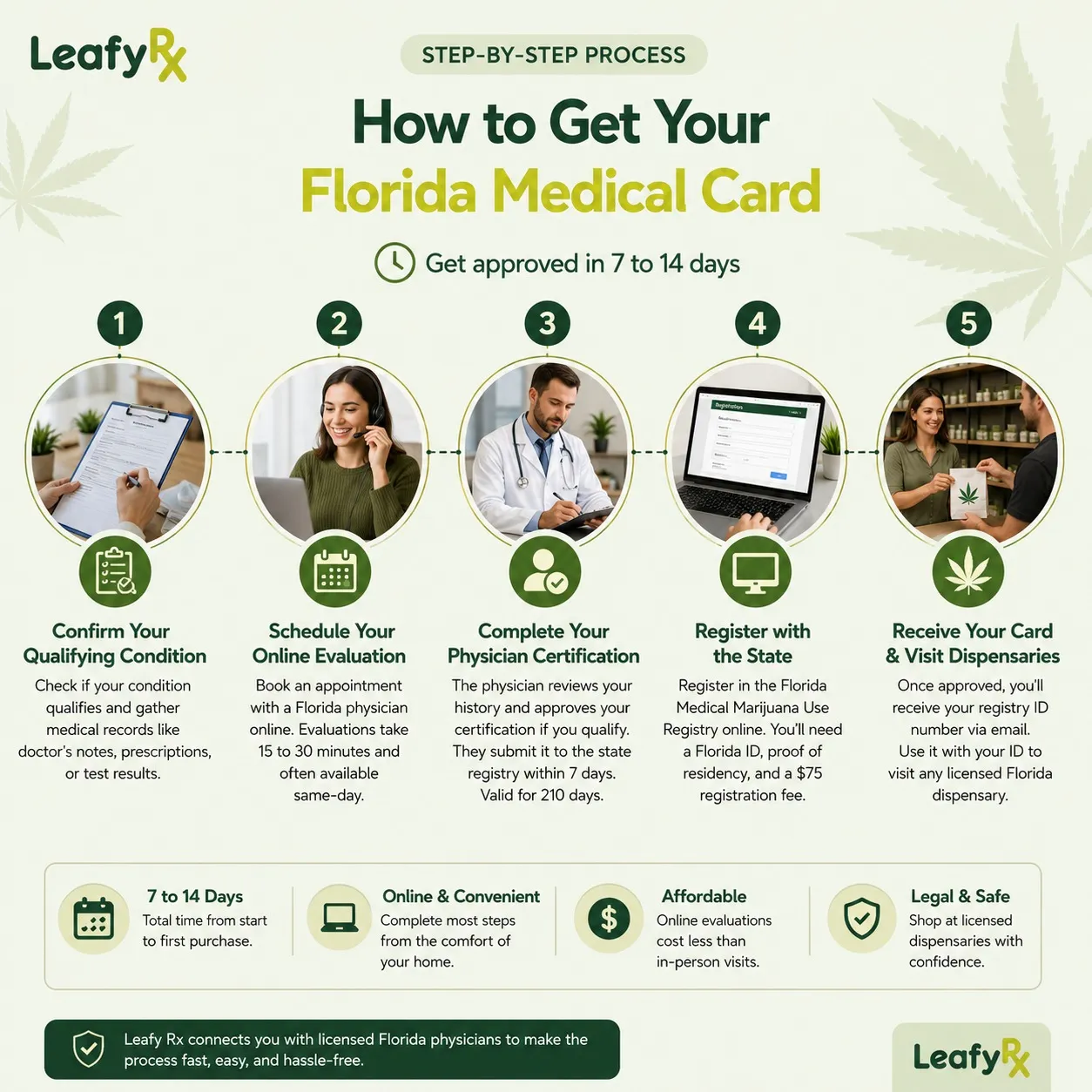
Getting a medical card in Florida is simpler than most people think. The process takes 7 to 14 days from start to finish. You can complete most steps from home.
Step 1: Confirm Your Qualifying Condition
First, check if your condition qualifies. Florida law covers chronic pain, PTSD, cancer, epilepsy, and several other conditions. You need medical records that document your diagnosis and treatment history.
Gather any relevant paperwork before your evaluation. This includes doctor’s notes, prescription records, or test results. Having these ready speeds up the approval process.
Step 2: Schedule Your Online Evaluation
Next, book an appointment with a Florida physician qualified to certify medical marijuana patients. Leafy Rx connects you with licensed doctors who can evaluate you online. The evaluation typically takes 15 to 30 minutes.
Online evaluations cost less than in-person visits. You can schedule same-day appointments in most cases. This saves you time and money compared to traditional clinics.
Step 3: Complete Your Physician Certification
During your evaluation, the physician reviews your condition and medical history. They ask about your symptoms and current treatments. If you qualify, they approve your certification on the spot.
The physician enters your certification into the state registry within 7 days. You receive a confirmation email once this step is complete. This certification is valid for 210 days before renewal.
Step 4: Register with the State
After certification, register yourself in the Florida Medical Marijuana Use Registry. You need a valid Florida ID and proof of residency. The state registration fee is $75.
The registration process is entirely online. You create an account, upload your documents, and pay the fee. Most applications are processed within 5 business days.
Step 5: Receive Your Card and Visit Dispensaries
Once approved, you receive your registry ID number via email. This number serves as your medical card in Florida. You don’t wait for a physical card to arrive.
You can visit any licensed Florida dispensary immediately with your ID number. Bring a government-issued photo ID along with your registry number. Dispensary staff will verify your registration and help you choose products.
The entire process from evaluation to first purchase takes 7 to 14 days for most patients. Online services like Leafy Rx make the physician evaluation step fast and convenient. You avoid long wait times and complicated paperwork.
Costs and Fees: What You’ll Pay for a Florida Medical Card in 2026
Getting a medical card in Florida involves two main expenses: the physician evaluation and the state registration fee. You’ll pay these costs upfront in year one. After that, annual renewals keep your card active.
The total first-year cost ranges from $174 to $375. This depends on which physician service you choose. Online platforms offer the lowest prices. Traditional clinics charge more.
Leafy Rx Evaluation Costs
Leafy Rx offers online medical card evaluations starting at $99 to $149. This is significantly lower than in-person clinics. You complete the entire process from home.
The evaluation connects you with licensed Florida doctors. They review your qualifying condition and issue your certification. Most appointments take under 30 minutes.
Leafy Rx provides a money-back guarantee if you’re not approved. This removes the financial risk. Over 100,000 patients have used the service nationwide.
Florida State Registration Fee
Florida charges a $75 annual registration fee. You pay this directly to the Department of Health. This fee is separate from your physician evaluation cost.
The state fee applies to all patients. There are no income-based waivers or reductions. You must pay this fee each year to keep your card active.
After your doctor submits your certification, you register through the state’s online portal. The $75 fee processes your application. Your card arrives within days of approval.
Annual Renewal Expenses
Renewal evaluations in subsequent years typically cost less. Physicians charge $99 to $200 for renewal visits. You also pay the $75 state fee again.
Total renewal costs range from $174 to $275 annually. Some doctors offer discounted renewal rates for existing patients. Leafy Rx maintains competitive renewal pricing.
You must renew before your card expires. Most patients set calendar reminders 30 days before expiration. This prevents gaps in legal access.
Total Cost Breakdown
Here’s what you’ll pay for a medical card in Florida:
-
Leafy Rx evaluation: $99 to $149
-
Traditional clinic evaluation: $150 to $300
-
Florida state fee: $75
-
First-year total with Leafy Rx: $174 to $224
-
First-year total with clinic: $225 to $375
Medical card holders save money at dispensaries. You avoid higher recreational taxes that other states charge. Patients save an average of 15 to 20 percent on purchases compared to recreational buyers.
These savings add up quickly for regular users. The card cost pays for itself within months. For detailed comparisons across all states, see the complete guide on medical marijuana card costs.
Medical purchases aren’t covered by insurance. You pay out of pocket for both the card and your products. However, the tax savings make the card worthwhile for most patients.
Eligibility Requirements: Who Can Get a Medical Card in Florida
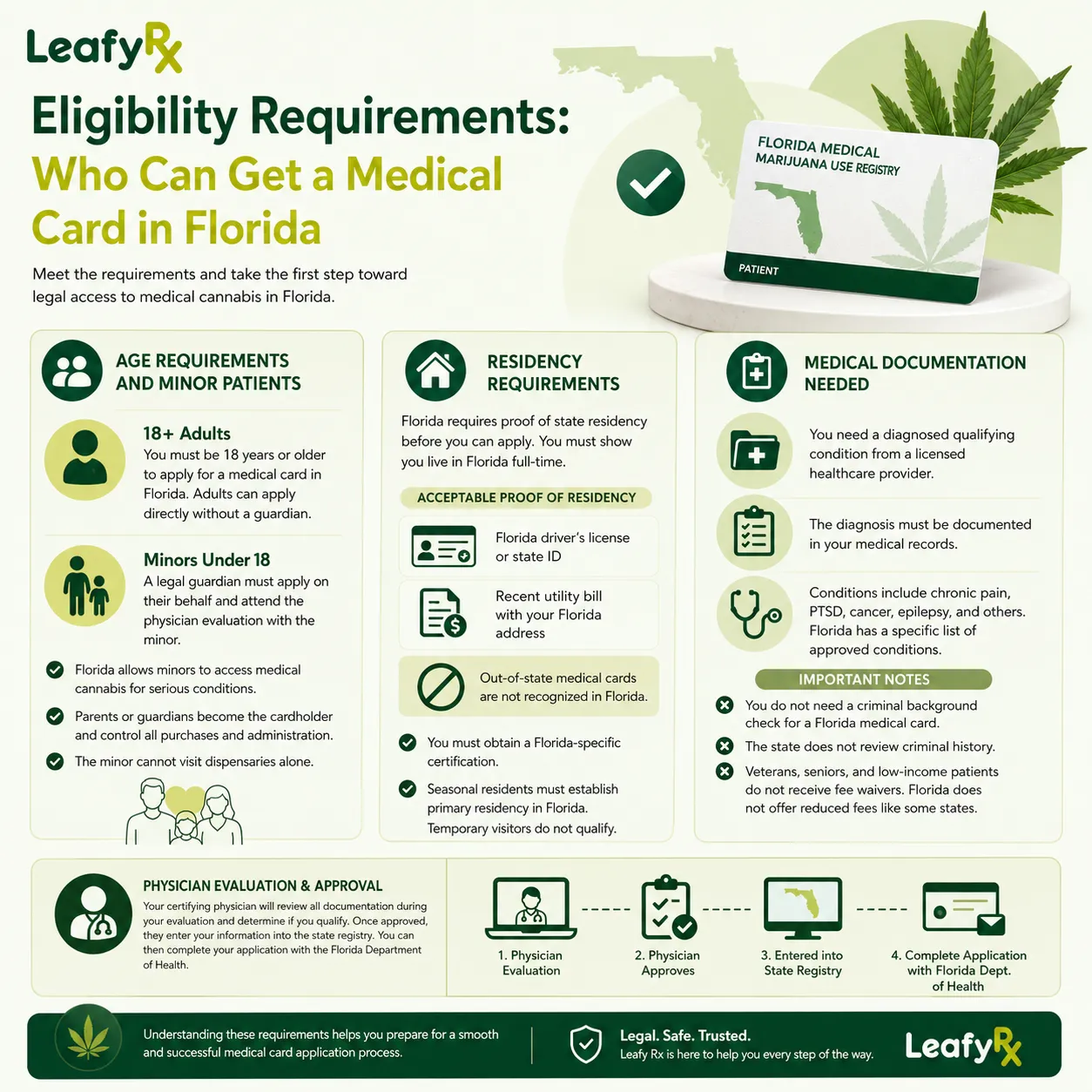
Getting a medical card in Florida starts with meeting specific eligibility criteria. You must be a Florida resident with proof of residency. You also need a diagnosed qualifying condition. The state has clear rules about age, residency, and documentation. Understanding these requirements helps you prepare for your application.
Age Requirements and Minor Patients
You must be 18 years or older to apply for a medical card in Florida. Adults can apply directly without a guardian. Minors under 18 can also qualify. However, a legal guardian must apply on their behalf.
The guardian needs to complete the application process. They must also attend the physician evaluation with the minor. Florida allows minors to access medical cannabis for serious conditions. This includes epilepsy, cancer, and severe chronic pain.
Parents or guardians become the cardholder. They control all purchases and administration. The minor cannot visit dispensaries alone. This protects young patients while allowing access to treatment.
Residency Requirements
Florida requires proof of state residency before you can apply. You need to show you live in Florida full-time. Acceptable documents include a Florida driver’s license or state ID. You can also use a recent utility bill with your Florida address.
Out-of-state medical cards are not recognized in Florida. You cannot use a card from another state to buy cannabis here. You must obtain a Florida-specific certification. This applies even if you hold a valid card elsewhere.
Seasonal residents face challenges. You need to establish primary residency in Florida. Temporary visitors cannot qualify for the program. According to qualifying conditions and requirements guidelines, residency verification is strictly enforced. The state checks all documentation carefully.
Medical Documentation Needed
You need a diagnosed qualifying condition from a licensed healthcare provider. The diagnosis must be documented in your medical records. Conditions include chronic pain, PTSD, cancer, epilepsy, and others. Florida has a specific list of approved conditions.
Medical records strengthen your application significantly. Bring documentation showing your diagnosis and treatment history. Include records of current symptoms and medications. This helps your certifying physician evaluate your case.
You do not need a criminal background check for a Florida medical card. The state does not review criminal history. Veterans, seniors, and low-income patients do not receive fee waivers. Florida does not offer reduced fees like some other states.
Your certifying physician will review all documentation during your evaluation. They determine if you qualify based on your condition. Once approved, they enter your information into the state registry. You can then complete your application with the Florida Department of Health.
Finding a Qualified Physician for Your Medical Card Evaluation
Getting a medical card in Florida starts with finding the right physician. Not just any doctor can certify you. Florida law sets strict requirements for who can recommend medical cannabis.
This step determines whether you qualify. It also shapes your entire experience with the state’s medical cannabis program.
Requirements for Florida Medical Marijuana Doctors
Only physicians licensed in Florida can certify patients for medical cannabis. They must complete a state-approved medical marijuana education course. This training covers dosing, delivery methods, and patient safety.
After completing the course, physicians register with the Florida Department of Health. They maintain an active profile in the physician registry. You can verify your doctor’s credentials through the state’s online database.
According to Doc MJ’s qualified physician requirements, doctors must also hold an active, unrestricted medical license in Florida. They cannot have disciplinary actions that would prevent them from recommending cannabis. The state monitors compliance closely.
These requirements protect patients. They ensure your certifying physician understands Florida’s medical cannabis program. They also guarantee your doctor knows how to evaluate qualifying conditions florida medical marijuana properly.
In-Person Clinics vs Telehealth Services
You have two main options for your evaluation. In-person cannabis clinics operate throughout Florida. They offer face-to-face consultations with physicians who specialize in medical cannabis.
However, in-person clinics often have drawbacks:
-
Longer wait times for appointments
-
Higher evaluation fees, typically $200 to $300
-
Travel time and parking hassles
-
Less flexible scheduling
Telehealth platforms like Leafy Rx offer a modern alternative. You connect with licensed Florida physicians via phone or video call. The evaluation happens from your home.
Telehealth benefits include:
-
Same-day or next-day appointments
-
Lower costs, often $49 to $99
-
No travel required
-
HIPAA-compliant secure platforms
-
Money-back guarantees if you don’t qualify
Both options are equally valid under Florida law. The state recognizes telehealth evaluations as legitimate. Your choice depends on personal preference and convenience.
What to Expect During Your Evaluation
The evaluation typically lasts 15 to 30 minutes. Your physician reviews your medical history first. They ask about current symptoms and how they affect daily life.
Next, they discuss prior treatments you’ve tried. This includes medications, therapies, and other interventions. They want to understand what has and hasn’t worked for you.
The physician then evaluates your qualifying condition. They determine if medical cannabis is appropriate for your situation. Florida recognizes conditions like chronic pain medical card florida, PTSD medical marijuana florida, cancer, epilepsy, and several others.
Bring these documents to support your application:
-
Medical records showing your diagnosis
-
Prescription history for related medications
-
Documentation from specialists or primary care doctors
-
Any test results or imaging reports
If you qualify, the physician enters your information into the state registry. You receive a certification that allows you to register with the Florida Department of Health. The entire process can be completed in one day using telehealth.
Most patients find the evaluation straightforward. Physicians who specialize in medical cannabis understand the florida medical cannabis program requirements. They guide you through each step clearly.
Medical Marijuana Products Available to Florida Card Holders
Florida card holders can access a wide range of medical marijuana products. Each type offers unique benefits for different conditions and preferences. Dispensaries across the state stock these options for patients.
Smokable Flower and Pre-Rolls
Florida allows smokable cannabis flower. The ban lifted in 2026 after years of restriction. Patients now enjoy this traditional consumption method. Florida Statutes Section 381.986 goes into more depth on this.
You can purchase up to 2.5 ounces every 35 days. This limit applies to smokable flower only. Other product types have separate allowances.
Pre-rolls offer convenience for patients who don’t want to grind flower. Many dispensaries sell single joints or multi-packs. Strains vary from high-THC options to balanced CBD ratios.
Vaporizers and Vape Cartridges
Vaporizers heat cannabis without combustion. This method reduces harmful byproducts compared to smoking. Effects appear within minutes of inhalation.
Vape cartridges come in dozens of strain-specific options. Some contain pure cannabis oil while others include natural terpenes. Battery-powered pens make dosing discreet and portable.
Patients report faster symptom relief with vaporizers. The bioavailability exceeds edibles by a considerable margin. This makes vaping ideal for acute pain or anxiety episodes.
Edibles, Tinctures, and Capsules
Edibles include gummies, chocolates, mints, and baked goods. Effects last 4-8 hours but take 30-90 minutes to start. This delayed onset requires patience for new users.
Tinctures go under your tongue for sublingual absorption. You’ll feel effects in 15-45 minutes. Droppers allow precise milligram dosing for consistent results.
Capsules work like traditional pills. They offer pharmaceutical-style delivery without taste or smell. Patients who take multiple medications often prefer this familiar format.
Topicals and Transdermal Patches
Topical creams and balms target specific body areas. They don’t produce psychoactive effects when applied to skin. Athletes use them for muscle soreness and joint inflammation.
Transdermal patches deliver cannabinoids through the skin over several hours. They provide steady relief for chronic conditions. Patches work well for patients who can’t inhale or swallow products.
All Florida dispensary products undergo lab testing. Labels show exact THC and CBD percentages. This transparency helps you choose products that match your medical needs.
Conclusion
Getting a medical card in Florida doesn’t have to be complicated. You now know the 11 qualifying conditions that make you eligible. You understand how chronic pain and PTSD fit into Florida’s medical cannabis program. You’ve seen the step-by-step process from physician evaluation to dispensary access. You know what costs to expect in 2026. You’ve learned how to find qualified medical marijuana doctors in Florida and what products you can access once approved.
The path forward is clear. Check if your condition qualifies under Florida law. Schedule an evaluation with a licensed physician. Complete your state registration. Start exploring treatment options at licensed dispensaries.
Don’t wait to find relief. Leafy Rx connects you with licensed Florida physicians who can evaluate your qualifying conditions and issue your certification quickly. Over 100,000 patients trust our platform. Start your application today and take control of your health through Florida’s medical marijuana card program.





 Ask ChatGPT
 Ask Claude
 Ask Perplexity